One Triton Square joins London’s best-connected buildings with Vorboss 100Gbps connectivity through British Land partnership

They’re all unique and need different levels of support. So, the most important thing for a business to do before they think about hiring on the IT front, is to work out exactly what they need right now and what kind of expertise and IT support they’ll need to reach their growth potential.
The skillset
Big, small or in-between, IT plays an important role in the make-up of every business in the UK today. Even seemingly basic functions often require a specialist skillset to create and maintain, which leads to the inevitable question – do we hire in-house resources or outsource our IT services?
There’s no doubt it’s a specialist hire, either way. When headhunting IT professionals, recruitment specialists look for candidates to be skilled in:
- Project management – essential for clear planning, regular updates, vendor management and good communication
- Quality assurance – central to developing software and systems
- Documentation – for designing clear processes, ensuring traceability and meeting regulatory compliance requirements
- Databases – given they’re at the heart of most software programmes
- Networks – because everything is connected, and understanding is key to troubleshooting
- HTML – so they can code websites
- Microsoft Office – as it’s so prevalent in the workspace
A more exhaustive list will also include:
- Programming and application development
- Experience on the help desk and technical support side
- Business intelligence and strong analytic skills
- Big data
That’s a lot to ask of any one person, or even a handful of people, but if you’re going to invest in IT as a service or pay a new employee to do the job, it’s important to hold out and get what you need, preferably in one strong package.
If budgets are tight, it’s even more important you don’t fall into the classic trap of hiring a new full-time IT guy who ticks a few of the key skills on your list, but not others, leaving you still needing to outsource to fill the gaps.
No matter how you dress it up, you’re paying twice, and you’ll have two sets of people to manage, when the aim was to make life easier.
The best advice you’ll get on this subject is to take time to weigh up the pros and cons first. Talk to recruiters, and see who’s out there. Talk to professional outsourced IT consultants and get a sense of what they can bring to the table above and beyond a regular hire.
You wouldn’t invest tens of thousands in office equipment every year without doing your homework, and services shouldn’t be any different. Look for reviews, recommendations, talk to people who’ve experience of using both, and weigh up the pros and cons.
That way, you’ll understand the risks and opportunities and can make a truly informed decision.
Weighing up the benefits
Benefits of in-house IT professionals:
- In-house IT work with your network every day, giving them time to learn its functionality and limitations in-depth.
- If employee integration is important to the core values of the organisation, in-house resources may allow a company to spend more time finding individuals who are the strongest match to the company culture.
- Downtime might be less if your in-house team are on site or on call 24/7.
Benefits of outsourced IT support:
- Operating and hire costs can be significantly reduced. Overheads will be leaner and there are no obligations like holidays or benefits. In fact, the benefits should flow in the opposite direction, allowing you to tap into things such as their buying power and vendor relationships.
- You can free up resources. If IT has been managed in-house up to now, chances are several people from across the business will have been picking up work to bridge the gap. By finding a full-time home for it, other employees will be able to focus on the job they were hired for and achieve more in their own roles.
- Expert help 24/7 means you get a trained professional to manage any IT project or issue that arises. No single hire can be expected to do everything, but with outsourcing, you’re guaranteed the best person for the job every time.
- You can reduce business risk. Outsource providers will keep pace with best practices in everything from software development to regulation and security. This means you’ll always be on the front foot and best placed to avoid unnecessary risk.
- Retention and motivation aren’t an issue. It’s a contractor’s job to keep the client happy, not the other way around, which can save the business significant amounts of time, effort and money.
- Up-to-the minute training, market knowledge and competitor insight is a given as outsourcers bring a wealth of knowledge and experience from other businesses to yours.
- Flexibility and scalability is easy if you pay for outsourced services as they’re used. Remember in-house resource needs to be paid, whether it’s been a quiet or busy month on the IT front.
- By tapping into an outsource company’s inventory, you may be able to invest less in equipment and software without risking efficiency.
Next steps
To get off on the right foot, we suggest:
- Setting clear goals and objectives, you’re crystal clear about what your business needs and the kind of relationship you want.
- Insist on project management, whatever route you decide to go down. It’s an invaluable skill and you’ll experience the downside very quickly if you hire without it.
- Be diligent, follow through on references, and encourage the person or outsource provider to prove their worth with examples of the kind of projects they’ve worked on before, and the value they added.
- Get key decision makers involved early in the process so you have the buy-in and support you need when you’re ready to take the leap.
- Stay involved. You don’t need to micro-manage anyone, but by remaining an active part of the IT conversation, you’ll be much more informed on what’s working, what’s not, and the direction the business needs to go in to continue to grow.
- It will also allow IT services to better align with business needs.
- Legislation coming down the tracks in May 2018, in the form of the General Data Protection Regulation, will increase the obligations of any business that uses or processes personal data, so it makes sense to include the IT solutions that can make this happen in your thinking, if you haven’t already.
- Don’t just go with the cheapest. You don’t have to spend a fortune for good IT support, but you do have to spend wisely, so make sure costs are affordable and can be justified.
Optimity can help any business considering an outsourced service. That starts with answering your questions and helping you get a sense of what you need, so you can make decisions that will benefit your business now and in years to come.
Recruitment for key employees and popular skillsets take time, so if your business has bagged itself some new talent, chances are you’ve already invested heavily. The search may have started months ago, you’ve paid a recruitment company to organise interviews and negotiated on the package that would eventually win them over. So why stop trying the minute they decide to come onboard?
Onboarding 101
How you handle an employee’s first few days in the business is crucial. We’ve all been hired at some point by a business that was totally unprepared for our arrival and the experience is not a good one.
A lack of preparation can lead to the employee feeling out of place, unhelpful – a burden even. And in many cases, they’re at the mercy of another colleague stepping in, simply because they feel sorry for this ‘IT nomad’ who doesn’t know where to start.
It’s an embarrassing start for any business and is completely unnecessary. Onboarding using IT isn’t a new phenomenon and it’s something growing businesses will have to repeat regularly, so why not take a little time to crack it once and for all, and let the process run itself?
Here are five good reasons to get onboarding right from day one
1 - A good onboarding strategy can save money
Replacing an employee costs money and putting them on the clock (and payroll) before you have:
- A desk
- A phone
- A computer
- Login details
- The right software
- A functioning printer
- An email address and account
- Access to folders, online information and the company’s cloud
….all the things you need to make them a productive member of the team, is a massive waste of their time and your money.
2 - It speaks to who you are as a business
The onboarding process is the first step in the employee lifecycle and one of the most important opportunities you’ll get to demonstrate how you operate as a business, the kind of culture you foster and the importance you place on helping employees settle in.
Using smart technology, less paperwork and automation, businesses of any size can create fun and engaging onboarding processes that:
- Allow employees to take more ownership of the onboarding process
- Make the process more dynamic, efficient and effective, and
- Empower new starts with the tools, information and access they need to start contributing as soon as possible
3 - It arms the employee with the right tools to do their job
Different roles need different tools and by including your IT experts in the process, you can make sure any IT investment is business-appropriate and justifiable.
Roles and responsibilities can be assessed and recommendations made on the best devices, networks and software, to do the job well.
Machine management and parity has a huge role to play here too, allowing businesses to roll out like-for-like systems for employees who do similar jobs, or customised set-ups for more specialised roles like coders, designers or site engineers.
4 - It aids retention
Not everyone who walks through the door is 100% convinced about their new role. Sometimes jobs are offered on a trial basis or an employee might make the leap with a ‘we’ll see how it goes’ mentality.
According to this article in Forbes, close to 20% will leave in the first few weeks, if no one has given any thought to their immediate needs, such as setting up their devices, whether in-company or their own device, and providing necessary training.
5 - Employees will take onboarding as their cue on how to act
Businesses who adopt a lacklustre and unattentive approach to onboarding run the risk of setting the bar low. On the flip side of that, appreciation breeds motivation, so the earlier you invest in your employees, the sooner they’re likely to give back.
IT can support all of this and help grow your business
Onboarding shouldn’t be regarded as something to get out of the way, or even a single event. It’s the first step in what should be an exciting journey for each new employee and an on-going talent strategy for the business.
IT can help with that. If you have in-house resource or work with an outsourced service provider, ask them to put employee onboarding on the IT roadmap and make good on their knowledge and expertise to improve the process and make life easier for everyone.
Discover how IT can help in onboarding and all other aspects of your business.
Business leaders and IT management have a responsibility to make the right technology choices to make a business run more smoothly and everyone’s lives easier. That means implementing IT strategies that save time and money and leave enough resource to look ahead and dabble with innovation to keep your IT infrastructure up to date.
What is the starting point for future-proofing your IT?
It’s important to think about the market you operate in, how it’s evolving and whether your proposition is keeping pace with industry change and the competition.
A thorough review of your IT system will help you assess how efficiently you run right now and, coupled with any ‘wish list upgrades’ in the pipeline, you’ll have a starting point for where you are and where you need to go with your IT roadmap.
If you don’t have IT experts in-house, an outsourced IT service provider or IT consultancy can help you make that assessment and talk you through the options for protecting what you have and moving things on at the rate you can afford.
Don’t worry if there’s a sizeable gap between where you are and where you want to be. Every business sits on that trajectory to some degree and the rate at which you can (and should) move up it is relative. Even small businesses can avail of affordable IT to help them grow. There’s a comfortable path for every business, and understanding what that is, is the first step.
There are a number of key questions for business owners and management teams to ask of themselves, to really get inside the nature of the business, the market and what future development might look like:
- Is the core product my customer buys changing (e.g. movies in video format to online streaming)?
- Are the core technologies of production changing (e.g. 3D printing)?
- Is the competition changing (e.g. new entrants claiming market share)?
- Is my relationship with the customer being disintermediated (e.g. search engines)?
- Is my industry undergoing regulation, deregulation, or re-regulation (e.g. have my responsibilities around data protection and information security compliance changed, as they will with GDPR)?
When you know the answers to these questions, you will be better able to decide what IT upgrades you will need to not only meet current operational demands, but those that will shape the future of your business. For instance, acknowledging that your server is in danger of becoming outdated may mean a move to the cloud is advisable, while an increase in IT demands may require considering hiring a virtual CIO or the support of an IT service desk to handle the day-to-day tasks that are getting in the way of you focusing on running the business.
In such a scenario, you may have to think about upgrading your IT architecture with enhanced project information management software so you can keep on top of all files and important emails to increase efficiency and enhance the service you provide.
By staying on top of these issues and knowing what plans to put in place, a business can help minimise the impact of change, focus their energy and IT budget where it will benefit it most and future proof in a much more complete sense.
Discover how effective project information management is just one way in which you can future-proof your business.
1. Increased organisation
Systems are designed to manage high volumes, so no matter how busy it gets, things never get messy, confused or lost.
With an efficient ticket management system, tasks can be sorted and requested any number of ways including by date, time, customer name, importance and category. Updates can be added and tracked, so it’s easy to see how the resolution is progressing and what’s still to be done.
2. Greater efficiency
The more organised you are, the more efficient you’re likely to be and that will come through in:
- Response times
- Resolve times and
- Reduced complications and errors
3. Faster turnaround of issues
Speed counts in business and for some issues, minutes rather than days, is the only acceptable turnaround time. With a managed help desk, businesses can ensure issues are prioritised and given the attention they deserve, in order.
4. Better prioritisation
The ability to rank issues is crucial. Whether it’s a serious cyber health and safety issue or a red flag because the problem concerns one of your high net worth clients, the ability to look at issues in a sensible order is key. By doing this, you can prioritise, for example, the threat of malware or even a full-scale tech disaster over less crucial issues such as fixing the copier.
5. Useful data and analytics
Individual tickets might not tell you too much about a business, but there’s a huge amount of benefit in the collective data.
By documenting information such as ticket importance, resolve time and frequency, you can gain valuable insights, and dashboards will help identify how IT resources and budget are being spent and whether your IT support is performing well.
If the system is being used to manage internal IT issues, you can see where recurring issues are happening, system upgrades are required or where additional employee training might reduce the number of tickets raised.
If it’s tracking customer-facing issues, you can see where complaints and compliments are logged against sales staff, which products or services customers are struggling to use and geographical trends or hotspots for increased sales or call volumes.
6. Clear issue allocation and ownership
Managed help desks can use that historical information and even assign specific tickets to people with particular skill sets or experience in dealing with known issues.
From a company perspective, it helps get the ticket through the system quickly, and from a customer perspective, they get help from the person best placed to resolve their issue quickly.
7. Positive brand experience
Being able to get the right support when you need it is a huge part of a good brand experience. You only have to look to social media to see how little patience consumers have when things go wrong.
By having a managed system that allows customers to talk to someone about the issues they’re facing and reassuring them it’s getting the attention it deserves, a business can actually improve its brand value on the back of an issue.
By owning the problem, making it their responsibility and managing the process in a professional way, customers are much more likely to stay loyal and become advocates.
8. Process automation
Some systems provide triggered updates that keep employees and customers in the loop with progress reports and target resolution dates. By sharing that information as it’s available, you can reduce the number of follow-up calls and emails (all of which need to be resourced) and reassure customers in the process.
9. Clearer lines of communication
Knowing whether you’re dealing with a customer who’s logged ten other problems this month or a glowing review last year is vital when it comes to customer care and brand management.
Customers don’t want to have to repeat themselves or provide the same information over and over. A managed help desk allows you to record and track all communication, ensures general information is captured first time round and makes everything available to administrators each time a request or issue is logged on that person’s behalf.
10. Allow employees to perform their key function
Tech issues can leave employees unable to do their job and tie your IT up in a constant ‘break-fix’ cycle, distracting them from more important future-proofing work that can help drive the business forward.
The benefits of an efficient IT service desk are clear, and availing of one from an expert provider who can act as a virtual CIO will not just help you save money and time in the long run, it will also help your business grow.
Learn more about how IT can help your business grow by downloading.
It’s the result of numerous, unstructured meetings, many of which come with documents or presentations attendees are asked to review up-front. The same meetings can follow up with reams of minutes and if you’re totally out of luck, produce a list of actions for you to pick up.
To turn this modern office nightmare around, businesses are looking to project and meeting management software to help standardise their approach and improve meeting effectiveness and efficiency with better preparation, organisation, structure and archiving.
How does meeting management software work?
It looks at the various stages and components required to run an effective meeting, helping organisers and attendees address the right things, at the right time.
Different software packages offer different features and benefits, but as a guide, this is the kind of support a business can expect from a good quality provider.
Before the meeting
This stage builds the foundation for the meeting itself, so it’s critical for providing clarity and giving attendees everything they need to prepare properly.
Receiving the agenda ten minutes before the meeting starts or worse still, at the meeting, means a second meeting is inevitable as employees are unable to come informed or have put any pre-work in.
Benefits:
- Meeting scheduling
- Agenda setting
- Agenda distribution
- Assigning pre-meeting tasks
During the meeting
At this stage, the software helps automate as much as possible, making the meeting run faster and smoother. If a specific decision maker can’t attend, automatic rescheduling can rearrange for a more suitable time.
The right software also helps ensure structure, so the agenda is discussed in a logical order and keeps pace, meaning items can be closed off or tabled with detail, if they need more work.
Assisted note taking helps save time while adding accountability and consistency. Good software can even offers voting tools, Pro/Con tools and rating systems to help find consensus and make decisions quickly.
Benefits:
- Noting attendance
- Covering agenda topics
- Taking minutes
- Decision making
- Assigning tasks
After the meeting
If a meeting’s effectiveness is determined by the results, well-presented minutes with search and merge functionality, easy distribution, security features and clear task allocation are a must.
Benefits:
- Consolidated meeting notes
- Minute documentation
- Minute distribution
- Minute archiving
- Assigning tasks
- Task follow-up
Here are six key benefits of Meeting Management Software:
1 - Paperless meetings
In stark contrast to the volumes of paper a meeting might usually require, a digital pack can be viewed by anybody given access to them, and on any device, allowing attendees to prepare for and act on meetings on the move, if you operate a CYOD/BYOD policy.
2 - Increased security
With cyber security so important, a business may fear documents with confidential or sensitive information being misplaced, but when you use meeting software you can make everything accessible online via cloud computing and add security measures to avoid the risk of information falling into the wrong hands.
Some providers even offer auto-purge features that mean you can wipe data from a device if it’s lost, stolen or several unauthorised attempts are made to access information.
3 - Improved collaboration
Efficient meetings are inclusive and encourage participants to get involved. They’re not always necessary, but where they can add value, presentations, video demonstrations, using a whiteboard to work through process issues or asking participants to ‘sticky note’ thoughts and ideas can help keep meetings interesting and achieve results faster.
4 - Synchronised information and real-time updates
By keeping everyone in the loop digitally, changes and updates can be made instantly, ensuring participants always have access to the most up-to-date information, and version control is well-managed. No more spending hours working on that set of tasks only to find out half of them have been replaced since you last opened the file.
5 - Simplified note taking
If you’ve ever run the agenda and acted as scribe for a meeting, you will be familiar with the scenario where you wrote down a shorthand note to come back to, only to later have no idea what it meant. It’s easy to miss important details or forget why you noted something as a result, because by the time you get around to writing up the notes, the context is gone. Automated meeting notes can help make sure nothing slips through the cracks and every meeting has comprehensive minutes that can be shared and archived.
6 - Improved participation at remote meetings
It won’t matter if participants are in opposite ends of the city, country or world with the right meeting software, as everyone can participate like they’re in the same room, saving time, cost and allowing progress to keep pace, despite busy schedules.
If you think your business could benefit from the many time and cost-saving opportunities meeting software creates, outsourced IT support from pebble.it can help get you up, running and managing meetings like a pro in no time.
Contact us to see how we can help you save time better spent running your business.
Effective IT isn’t about spending big, it’s about spending well, and there are a million and one things small business with limited resources can do to free up time and money, streamline operations and future-proof the enterprise.
Here are 10 great tips to help any small business optimise their IT opportunities
1 - Make yourself easy to find with a great website
Sites can be created, maintained and supported more easily and cost-effectively than ever, so there’s no need for expensive designers and in-house webmasters if you don’t need them.
A good site is one that:
- Uses SEO well, so search engines find you and position you well on results pages
- Cuts to the chase and presents the most valuable information first
- Reflects your business or brand well and exudes professionalism
- Is quick and easy to navigate
- Provides contacts and next steps
2 - Manage your social presence
There’s no substitute for social media if you’re a fast-paced brand that’s keen to connect with customers on real-time issues. Used well, it’s an excellent channel to build relationships with existing customers and demonstrate how you behave, as a brand, to prospects.
However, I’d say that if you don’t have time to manage social media accounts, don’t go there. Having a Facebook page won’t do your business any favours if it just sits bone idle.
When it comes to Twitter, tweet if you’ve something interesting to say or offer and if you don’t… don’t fill the virtual silence with things that aren’t business appropriate or take you into conversations that can get you into hot water.
Keep your accounts tight and if it means having just one and managing it well, that’s the way to go.
3 - Encourage remote working
It won’t work for everyone, but if you can afford to trial remote working for some of your employees or new hires, you might find it cheaper, more efficient and a sweetener that brings fresh talent to the honey pot.
Employees want more flexibility and they’re willing to hold out for employers that present opportunities that suit their lifestyles.
It’s a good bargaining tool for employers too, allowing you to offer remote working in lieu of other benefits you might not be able to afford, such as additional holidays, healthcare or subsidised gym memberships.
Contrary to what you might think, research shows remote workers are less distracted, take fewer breaks, work longer hours, are more productive and score higher in terms of job satisfaction, compared to their office-based colleagues, so it’s worth finding out how you can handle the increase in mobile device use.
4 - Gather and use data
If knowledge is power, data is a business’s super power. The right technology can make light work of collating, storing, sorting and reporting on customer analytics and this wealth of knowledge can be used to connect with relevance, planning marketing campaigns confident of where, when and how you can make the most impact.
5 - Use software to make life easier
Software designers have been pumping out products to help with everything from project management to invoicing and accounting, but you need to know which programmes, tools or apps are right for you by asking some IT questions up-front.
There’s no doubt the better programmes out there can save small businesses time, streamlining clunky processes and taking the stress out of everyday things such as meeting management and minutes - notorious for eating up valuable time.
This kind of software is affordable, easy to use and most providers offer free trials, so they cost nothing to try out.
6 - Make security a priority
Your business is only as strong as its network and if that goes down, your business goes down with it, so protection is key. Anti-virus, and malware and ransomware protection are a must, and regular updates and patches should be prioritised.
Getting employees on board is wise too, educating everyone on the risks and threats they’ll encounter day-to-day in their inbox and explaining the role they will play in keeping the business safe.
There’s no such thing as harmless chain mail and a quick lunch-break surf on a corrupt site could bring a world of pain for a small business.
7 - Have a back-up plan
The biggest decision around servers and back-up will be whether you go with a cloud-based or in-house solution. There are pros and cons to both and some business run with hybrid models. The most important thing is that you find what’s right for you.
If you’re not sure, you should talk to an IT service provider. This stuff is bread and butter for them and they’ll be able to make recommendations based on things such as whether you want to:
- Reduce reliance on the internet
- Allow employees to connect from anywhere
- Ensure high levels of uptime
- Increase data security
- Bolster business continuity or
- Ensure adequate disaster recovery
8 - Consider customer-facing tech and apps
Taking things online or giving customers an easier way to buy and use your services might make good business sense. A simple scheduling app or online tutorials could make all the difference in your industry, so take time out every now and then or ask an expert if there are opportunities or IT trends out there that you should be tapping into.
Technology might not be your forte, but that’s no reason to miss out on what could make your life easier and more profitable, when there is so much help available.
9 - Look at tech alternatives to reduce office overheads
Cost savings can be found in everything from office space to your telephone provider and decision makers need to look at how much they can save by making smarter tech-led choices.
For example, how much less space they would you need if your server was in the cloud and more employees worked remotely?
Could a VoIP phone system, allowing you to run calls, email, fax and video over one internet supported network, significantly reduce the cost of an underused land line service?
Legacy services and overheads have a habit of hanging around a lot longer than they should because of inertia or a lack of knowledge. It’s music to the providers ears, but an unnecessary drain on resources.
10 - Outsource and ask for help when you need it
If everyone was an IT expert, there would be no need for blogs like this, but we all come with different skill sets and smart business leaders and great IT managers understand their strengths and ask for help when they need it.
Outsourcing roles and tasks that simply can’t be supported within the business makes sense. With IT for example, it can be much cheaper to farm the work out to a virtual CIO or to an IT service desk than adding another skilled employee to the payroll and absorbing the costs of benefits, holidays, training, incentives and arming them with all the tools they need to do their job.
By putting something as important as IT in the hands of the experts, you can rest assured, you’ll always have access to the expertise you need, when you need it, and you don’t need to be a big business to afford it.
Latest from the press room
London, UK, 13 August 2026:
Vorboss, which owns and operates London’s dedicated business fibre network, has connected One Triton Square at Regent’s Place with 100Gbps connectivity, delivering exceptional digital capacity to one of the capital’s most exciting new destinations for science, technology and innovation.

The flagship British Land and Royal London Asset Management building provides more than 300,000 sq ft of purpose-built space, bringing together fitted laboratories, flexible workspace, premium dedicated offices, and shared meeting and event space.
Located in the heart of London’s Knowledge Quarter, One Triton Square is designed to support ambitious businesses at every stage of growth. Flexible floorplates, advanced digital infrastructure and exceptional on-site amenities create an environment where emerging organisations can scale alongside established global leaders. It is workspace built for collaboration and long-term success.

100Gbps is independently available on each floor, providing the capacity occupiers need to support increasingly data-intensive work and emerging technologies. The 100Gbps connection further reinforces One Triton Square’s position as a future-ready commercial destination.
Rhod Morgan, Co-CEO, Vorboss adds:
“Connecting One Triton Square with 100Gbps gives its occupiers the capacity they need not only for the way they work today, but for the technologies and opportunities that come next. It perfectly complements the vision British Land and Royal London Asset Management had for the building – a space designed around the needs of ambitious, innovation-led organisations”
“One Triton Square sits at the centre of London’s science and technology ecosystem, and we’re incredibly proud to be providing the infrastructure it needs to thrive.”
Simon Hepher, Head of Asset Management, Regent’s Place and Innovation Assets, British Land:
“One Triton Square is a landmark new building at the heart of Regent's Place, designed to support ambitious businesses at every stage - from agile start-ups to established global leaders. Alongside best-in-class laboratories, workspace, and offices, the building will now also offer some of the best digital connectivity in London, with 100Gbps providing occupiers the capacity they need for increasingly data-intensive work as they scale and grow.”
Mark Carroll, Property Development Director, Royal London Asset Management:
“As a long-term investor, we are focused on creating places where businesses can thrive. This investment in digital infrastructure further enhances One Triton Square's appeal to science, technology and innovation-led occupiers and supports its long-term success.”
The connection at One Triton Square forms part of Vorboss’ commitment to ensuring London has the serious digital infrastructure required to remain a leading global centre for business, science and technological innovation.
Ends.

The experience driving our growth
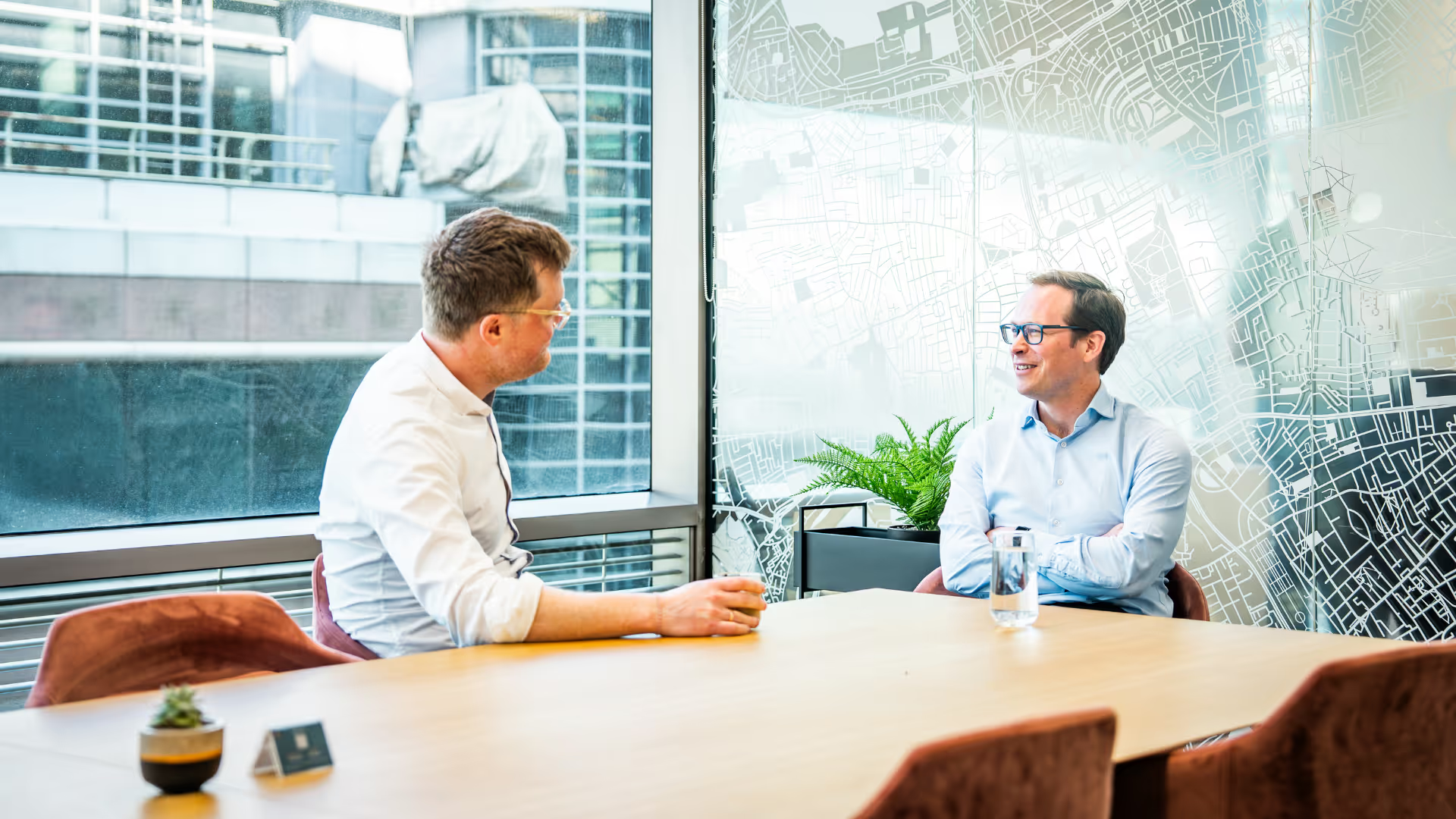
David has been central to our success as our Chief Financial Officer. Drawing on his experience at Zayo Group and RBC Capital Markets, he brings strong insight across large-scale infrastructure, investment banking and managed services. As our CFO, he’s been instrumental in shaping a commercial model that supports businesses as they grow, giving our customers the certainty and simplicity they expect.
Rhod has played a pivotal role in operations at Vorboss since 2020. He led the build of our network, now spanning over 900 km, and has raised industry standards across quality and efficiency, making sure our customers have a flawless experience. With previous roles at companies like Arup and WeWork, Rhod understands the complexity of London commercial real estate and knows exactly what it takes to deliver world-class technology in a fast-paced city.
The next chapter
Under David and Rhod’s leadership, we are doubling down on our commitment to keep things simple for our customers and remain the transparent, accountable provider ambitious businesses rely on as they grow.
“Vorboss is on path to becoming one of the UK’s leading B2B connectivity and managed service providers,”
says Adam Dunlop, Operating Partner at Octopus Capital and Chair of the Vorboss Board.
“With David and Rhod’s leadership, and the strength and commitment of the team across the business, I am genuinely excited about what lies ahead.”
Vorboss is part of the Fern Trading Group, managed and advised by Octopus Investments. This partnership, backed by £250million in funding, enabled us to build an independent, 100Gbps London fibre network and connect thousands of businesses across the capital. Having expanded our offering with a range of cybersecurity and managed technology solutions last year, we continue to do things differently by delivering everything end-to-end through our in-house teams.