One Triton joins London's best connected buildings with Vorboss 100Gbps
There are hundreds of thousands of browser extensions designed to help us to save time, be more productive, and personalise our online experience.
And while the majority of them do what they’re supposed to, some are not designed to help you at all…
If you’re unfortunate enough to download a malicious browser extension without realising, it could harm your productivity and even flood your work with unwanted advertising.
This is known as adware. It’s a form of malware (malicious software) that’s designed to bombard you with unwanted adverts.
It can also change your search engine and send you to affiliate pages when you’re making purchases. These activities generate revenue for the extension’s creators.
In a recent report from a cyber security company, it revealed more than 4 million of its customers have been attacked by adware hiding in browser extensions over the last couple of years.
And often people didn’t realise they were under attack.
There’s a darker scenario where these malicious extensions are hiding actual malware which can infect your computer.
This can lead to sensitive data such as your logins or even payment details being stolen. And of course malware can spread across an entire network.
To keep your business and its data safe from the risk of malicious browser extensions, it’s important you only ever download them from reliable and trusted sources.
Read reviews and look at ratings. If a browser seems too good to be true it probably is.
As the business owner, you might also look into controlling which extensions can be installed by your team.
We can help with this, as well as looking at up-to-date software protection and (fun) security training for your team.
Back in May, we heard there would soon be a successor to the password – the Passkey.
Now, we’re hearing that Apple will start rolling out Passkeys in the next few months in iOS 16. And we’re excited.
Though it’s caused a bit of confusion. Apple is going to great lengths to market the Passkey, and understandably, people have assumed that it’s a feature exclusive to Apple.
That’s not the case!
In fact, Passkeys will be used in a joint effort to boost online security by Apple, Microsoft and Google. The reason Apple is promoting this new feature so hard is to get the message out there.
Microsoft and Google are also keen to spread the word so that people understand how Passkeys work.
The more people take advantage of Passkeys, the safer our businesses are online.
Passkeys – otherwise known as FIDO authentication – work by letting you log into an app or website with just your username and your pre-authenticated device, most probably your phone.
Your device generates a cryptographic token, which makes the second part of a cryptographic key pair. When the pair matches, you’re allowed access to the app or website.
What that means in practice is when you’re logging in, you just use your phone to prove its really you. You’ll just unlock it using your face, fingerprint or PIN.
So long as your phone is within Bluetooth range of your computer it will work.
And without needing a password… bliss…
It’s a far more secure way to access apps and keep your accounts safe from cyber criminals. You never see your cryptographic token, so it takes away a lot of the danger of having your login credentials stolen.
Cyber criminals will be unable to use their normal tactics – such phishing emails, brute force attacks, or key loggers – to steal your credentials.
They’ll need your physical device, making remote hacking much less likely.
If you use Windows Hello, you’ll see that Passkeys are already supported. And it won’t be long until all three tech giants roll out support across their entire product range.
Before then, if you’d like any help or advice on keeping your apps and accounts safer, just give us a call!
Phishing scams are one of the biggest security threats to your business right now.
A massive 83% of organisations said they suffered successful attacks last year. And with just under a third of phishing emails being opened, the chances that someone in your business will be fooled are high.
But to make matters more difficult, cyber criminals have borrowed a technique from ransomware groups that is designed to panic people into taking action and giving away their login details.
This new kind of phishing attack begins like most others.
You get an email alerting you to potentially suspicious activity on your account. It might say someone is trying to login from a different location or device and the attempt has been blocked.
You’re then asked to click a link to verify your email address and password. That’s worrying enough, right?
But what makes this phishing attack even more dangerous, is the countdown timer that appears on screen.
Typically, it’s set at one hour, and you’re asked to confirm your details before the countdown ends, otherwise your account will be deleted. Yes, deleted! That catches a lot of people’s attention.
This is a powerful manipulation tactic designed to scare people into taking immediate action – and think later.
In reality, if that countdown hits zero nothing will happen. But watching the seconds count down can give you a sense of urgency that makes you forget to check whether an email is the real deal or not.
The page you’re entering your details on is fake. Criminals will steal your details and login to your real account. That’s a major problem you don’t ever want your business to face.
You’ll be at risk of data theft, financial loss, or malware, as well as potentially putting other accounts at risk (if you’ve reused your password).
Your login details may even be sold on the dark web, giving other cyber criminals the opportunity to break into your account.
Here are some basic phishing protections for you and your team.
- Look at the email address the email was sent from. Make sure the spelling and grammar are both correct, and hover over links to see what website address they are trying to send you to.
- If you think you’ve fallen for this kind of scam, it’s important you change your login details immediately. Don’t click a link in an email – type in the website address in your browser.
- We’d also recommend using a password manager. This is software that creates long and strong random passwords that are impossible to guess for every account you have.
- It will store these passwords for you. And autofill login boxes to save you time (yes, password managers detect when they’re being asked to fill in details on a different page, such as a fake phishing page).
Share this article with your whole team right now!
And if anyone ever clicks a link they’re not sure about, ask us how to keep your business safe.
Using a cloud server to drive your business’s technology is a smart idea. The benefits are huge!
You can use as little or as much storage as you need, without having to worry about limitations or huge bills. Perfect for growing businesses.
Your team can access any data anywhere. Cloud servers were made for the hybrid work world we have today.
And you don’t need to use lots of your office space to house big servers and other equipment.
But when you’re using a cloud server, you must make sure it’s properly secured.
A recent report has revealed cloud servers are increasingly being used as an entry point for cyber criminals to launch attacks.
A huge 41% of businesses that have been hacked revealed their cloud server was how cyber criminals got in.
Scarily, this figure is rising 10% year on year.
Why? Often, it’s because companies don’t invest as much into the security of their cloud servers as they should.
In technology as in life, you really do get what you pay for. Many of the free cloud servers available don’t provide the same level of security and encryption that paid-for services do. Often they are less reliable as well.
It’s vital that your business does full research when choosing a cloud server to make sure it meets all your requirements and is as safe as possible.
Better still, ask an expert to do this research for you (we can help).
We also recommend a few standard security measures are always followed.
Give all of your team a password manager to encourage them to generate separate long random passwords for every login they have.
The beauty of password managers is they’ll remember these passwords and even autofill the login boxes. That means better security and greater convenience in one package.
You should also provide regular cyber security training for everyone in your business. Business emails are the second most likely place an attack will start.
The first line of defence should always be a human asking themselves “wait, does this look right?”
It’s never possible to prevent 100% of attacks. But if you take all the right steps to keep your business safe your chances of suffering a successful attack go down dramatically.
If you’d like help choosing the right cloud server for your business, we can advise you – get in touch.
For the past couple of years, the tech world has been struggling with a huge shortage of chips.
But it’s not just tech businesses that are feeling the impact.
So many of the things we use every day contain a chip. Laptops and desktops, sure. But also household appliances, even our cars. It’s hard to find an electric device without a chip. This shortage has the potential to disrupt our modern lives.
Did you know, it’s been ongoing since 2020 (ah, that year really was a gift, wasn’t it)?
It started during the pandemic as production fell while demand went up. Other events since have made it worse, including extreme weather, the Ukraine war and a factory fire.
We’re told that increasing chip production isn’t easy. It can take years to build a new factory because of the unique production demands. Of course, all of this is someone else’s problem. Let’s make it real to you – what does this actually mean for your business?
Essentially it means you need to plan ahead more.
Some of the technology you need to run your business may be in short supply. As an example, getting large numbers of the same laptop might be difficult, compared to getting just 2 or 3.
And some of the essential devices you rarely think about as they’re in the background, such as network switches, are currently much harder to get. As you push your business towards increased growth it means planning ahead more than ever before.
Industry experts expect the shortage to last into next year… and it could be even longer.
Would you like to run your growth plans by us, so we can advise what might need to be ordered, when?
Get in touch!
There’s no denying the Windows 11 has a lot of really cool new features.
If you haven’t made the move from Windows 10 yet, you’re missing out.
But there’s good news. To make the (eventual) move from Windows 10 to 11 a little easier, Microsoft is sharing a couple of 11’s most useful features.
The first should make printing a little easier. We can hear your cheers from here! Anything that makes printing easier is OK in our book too. Printers don’t have a terrible reputation for nothing…
This feature makes printing PIN-protected. That means when you want to print a document, you’ll send it off to the printer – but it’ll only print when you’ve reached the printer and entered your PIN.
This removes the risk of you printing something confidential and leaving it on the printer for everyone to see.
Or accidentally printing several copies of the same document. Yes, this will reduce paper waste.
And that’s not all…
There’s a second really useful feature coming over to Windows 10. It’s called Focus Assist and works alongside do not disturb.
Switching on do not disturb is great when you want a little uninterrupted time to finish a task or do some research. But if you use it a lot, you might miss a notification that you really needed to see.
Focus Assist stops that from happening. You use it alongside do not disturb and it still allows important and time-sensitive notifications and messages to reach you.
These features have been in testing since June this year. There’s still no date for when they’ll be released to everyone with Windows 10. But they’re on their way.
If you can’t wait to try more of the time saving and productivity boosting features that Windows 11 has to offer, give us a call to see how we can help you make the switch.
Latest from the press room


LONDON, UK: 15 September 2026 – Here East, the multi-award-winning hub for innovation and creativity, today announces a strategic partnership with Vorboss to deliver dedicated 400Gbps fibre connectivity across its campus.
With demand for ultrafast, enterprise-grade connectivity accelerating, the investment will elevate the campus’s digital backbone to world-class standards, enabling organisations to innovate without limits and scale at speed.
The partnership comes as Here East cements its position as one of Europe’s most ambitious and globally competitive innovation ecosystems, with rapid growth in world-leading organisations spanning AI, advanced content production and emerging technologies.
The announcement lands at a defining moment for London’s innovation economy. In 2026 alone, the capital attracted $12.6bn in tech investment - the third highest of any city globally and the highest in Europe - while producing 12 new unicorns, more than any other European city.
Vorboss will install a core network node at Here East. Unlike a standard fibre connection, where traffic is carried back to a provider's data centre or telephone exchange, a Vorboss node means internet connectivity effectively originates from within the campus itself. This delivers dedicated 400Gbps fibre connectivity, exceptional speed, low latency, resilience and performance at a scale rarely available in urban campuses.
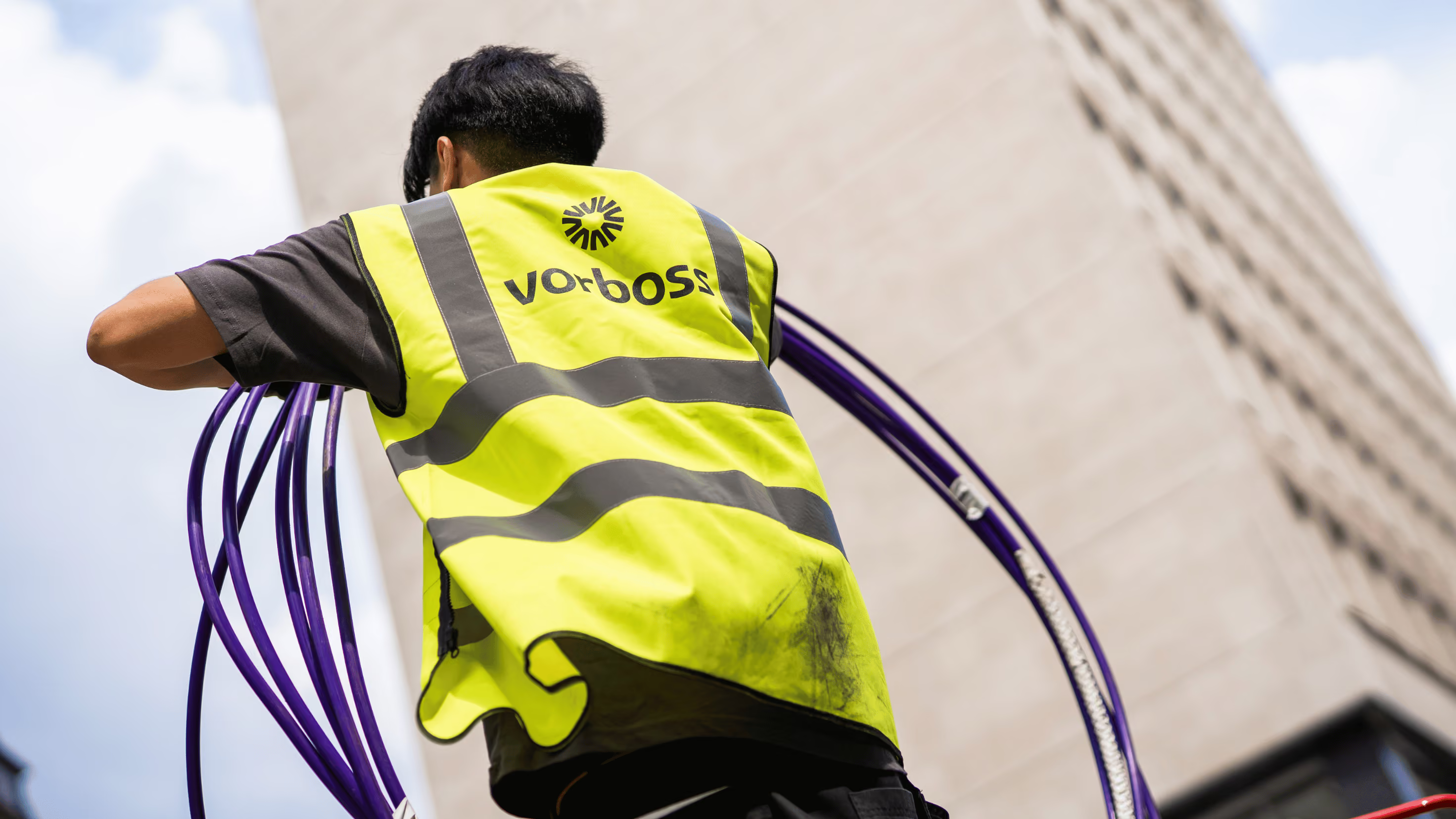
The upgrade significantly enhances Here East’s ability to support organisations operating at the frontier of innovation, from high-growth start-ups to global industry leaders. Unlike traditional providers, Vorboss owns and operates its network end-to-end, ensuring unmatched control, accountability and consistently high performance.
Located in the Queen Elizabeth Olympic Park, Here East is home to a unique concentration of pioneering institutions, global brands and creative leaders, including V&A East Storehouse, Sports Interactive, Ford Mobility, Hawk London and six global universities. More than 7,000 people collaborate, experiment and build the future on site each day, making it one of the most vibrant and influential innovation and creative communities in Europe.
By integrating Vorboss’s cutting-edge fibre network, which was built to power London’s data-hungry businesses, Here East is setting a new benchmark for connected campuses, ensuring its community can handle exponential data growth, accelerate innovation cycles and unlock entirely new frontiers of opportunity.

Gavin Poole, CEO of Here East, commented:
“Businesses working at the forefront of AI, data and content creation need infrastructure that can match their ambition and pace of change.
Here East was created to bring together the industries shaping the future - from advanced technology to the creative sector - in a single, collaborative environment. Delivering on that vision means providing not just exceptional space, but infrastructure of a truly global standard.
Our partnership with Vorboss ensures that as our ecosystem continues to grow, it is supported by the speed, scale and resilience required to lead on the world stage.”
Rhod Morgan, Co-CEO at Vorboss, added:
“Here East is exactly the kind of place our network was built for: ambitious, data-hungry organisations that need infrastructure that keeps pace with their growth.
Connecting the campus with 400Gbps means we’re bringing high-capacity infrastructure directly to one of London’s most important innovation hubs. With dedicated capacity, Here East’s tenants get the speed, resilience and headroom they need to scale without being held back by connectivity.”
ENDS
Notes to editors
About Here East
Here East is London’s multi-award-winning campus, home to more than 7,000 people working and studying on site to create at scale: from global technology companies and start-ups, to major academic institutions and pioneers in the creative industries.
Designed for cultural institutions and businesses that want the freedom to experiment, collaborate, and grow, the 1.2 million sq ft campus offers a spectrum of spaces, from creative offices to expansive warehouse studios.
The ecosystem is home to over 30 organisations, including Plexal, the innovation centre and co-working space; Sports Interactive; FORD, Human Centred Design Complex; Studio Wayne McGregor; and The Trampery on the Gantry, which provides low-cost studios for creative businesses and artists. Five of the UK’s leading universities are also based on campus, including UCL and Loughborough University London, along with major cultural institutions including the V&A East Storehouse.
Built within the former Olympic Press and Broadcast Centre, Here East is owned by clients of Delancey, a specialist real estate investment advisory company. It has been recognised by the International Olympic Committee as one of the most successful post-Olympic regeneration projects in the world.
About Vorboss
Vorboss owns and operates London’s leading dedicated business fibre network, built from the ground up for the city’s most demanding organisations. Its high-performance infrastructure delivers the speed and resilience needed by businesses working with AI, advanced content production and data-intensive technologies.
Vorboss also provides IT and Cybersecurity support and services giving businesses greater control over the technology they rely on, backed by one expert team, one number to call, and support from people who take it personally.
Media contact
For press inquiries, interviews, or further information, please contact:
● Email: press@hereeast.com
● Website: www.hereeast.com/press