One Triton Square joins London’s best-connected buildings with Vorboss 100Gbps connectivity through British Land partnership


Vorboss formalises strategic partnership with Roc Technologies to deliver innovative connectivity services to London's local councils.
London, [02.06.2025] – Vorboss, London's leading dedicated connectivity provider, today announces a strategic partnership with Roc Technologies to deliver best-in-class network solutions tailored specifically for local councils across the capital.
This partnership, borne of long standing collaboration between the companies, brings together two organisations committed to leveraging technology to enhance public sector services. The Vorboss high-performance, resilient network, combined with Roc Technologies' highly secure, customer-centred approach, provides local councils with a distinctive and robust solution to address real citizen needs.
Jason O’Malley, Chief of Commercial Operations at Vorboss, said: "We're excited to be partnering with Roc Technologies, whose values and customer-centric approach align closely with our own. This partnership enables us to offer unparalleled connectivity solutions, directly improving service delivery and efficiency for local councils."
Adam Jarvis , CRO at Roc Technologies, added: "Our partnership with Vorboss brings together two businesses that truly differentiate in the way they support their customers, providing highly responsive services designed to enhance their overall experience. Leveraging Vorboss' superior infrastructure and their technical experts located across London allows us to provide a combined service delivery capability that transforms how local councils manage their infrastructure, ultimately benefiting the communities they serve."
The combined expertise of Vorboss and Roc Technologies presents councils across London with an unmatched proposition: cutting-edge connectivity delivered with clarity, reliability, and a shared dedication to customer-driven outcomes.
ENDS
For further information, please contact:
Kirstie Lane
Kirstie.lane@vorboss.com
About Vorboss:
Vorboss is London’s dedicated enterprise fibre network. We are disrupting the status quo by providing London businesses with access to critical fibre infrastructure with simple, transparent pricing and London-wide coverage.
Since 2019, we've invested over £250 million into our London network. We have deployed over 700km of fibre optic cables to date, setting an unparalleled standard in both scale and quality.
We maintain complete ownership of the network that we built. This gives us the freedom to approach telecommunications differently.
Partners and customers deal directly with the engineers who built the network, and we can deliver installations and bandwidth upgrades within days, not months.
About Roc Technologies:
Who are Roc?
Roc Technologies delivers transformational IT solutions to public and private sector organisations across the UK. We are a team of brilliant minds, bringing together highly secure infrastructure, advanced cyber security, intelligent automation and modern cloud services, all supported by our 24/7 Managed Services Operations Centre. Our expertise is backed up by some of the UK’s most rigorous data and security accreditations; we’ve earned the trust of the nation’s largest and most complex organisations and have safeguarded their most sensitive data for over a decade.

At Vorboss, we have completely transformed business connectivity in London. By building a vertically integrated organisation, we have created a dedicated business fibre network that is driving London towards 10Gbps as a standard, a change that businesses desperately need.
Our innovative business model has allowed us to build a network with significantly more capacity, we start where others top out, connecting customers up to 100Gbps at market-leading rates. We also get customers connected much faster than the current industry standard, setting us apart.
Why did we throw out the traditional telecoms playbook? So we could redefine what's possible for London's underserved businesses. The Vorboss way isn't just a different way, it's a better way, and this is how we did it.
Building a disruptive business model

Building London's best full-coverage business fibre network was no small feat. 70% of the UK's connectivity demands are in Central London, but an ageing incumbent internet operator serves 80% of that market. It can't meet the needs of modern businesses, which is why we came in and built our network with the latest technology and newest design.
We built a future ready network that serves ambitious businesses. To date, we've deployed over 500 km of network in three years—a scale no other fibre company has taken on in Central London, especially in such a short amount of time.
We achieved this through vertical integration; by owning the entire value chain from fibre to service delivery, we have complete control over the quality and build of our network. We offer our customers the highest levels of reliability and flexibility, which isn’t possible with a traditional telecoms model.
Putting customers first
Unlike most telcos, we started by thinking about customers’ needs and worked backwards. A laser focus on market-leading bandwidth, capacity, and delivery has resulted in unassailable products for London's enterprises.
Vorboss is the only vertically integrated Internet Service Provider (ISP) dedicated to business in London. Our people-focused operational model maximises efficiency and delivers an outstanding customer experience.
Powering an unconventional model

Our belief that people come first and assets second led us to create an unconventional model for powering our network.
Creating a motivated workforce
To be truly vertically integrated, we had to start with our workforce. We created a certified training academy that takes people with zero telecoms experience and qualifies them to build our network. We are one of only a few UK ISPs that do all their training in-house; while it may not be the easy option, it is the only way to deliver the quality standard necessary for our ambitious customers.
Keeping our training in-house allows us to build diversity and inclusion into our team, addressing the industry's significant diversity problem from the ground up. By looking at real-life people rather than numbers, we have created a team that is engaged, motivated, and willing to think differently to solve problems for customers. This approach makes good business sense, but it's also the right thing to do; future decision-makers will want to buy from companies that share their values.
From planning to customer support, it is an exceptional customer experience from end-to-end. Our customers will only ever speak to members of the Vorboss team, not contractors.
Moving people and assets separately

Many of our employees are young Londoners who rely on public transportation to get around the city. Rather than limiting our talent pool to those who can drive, we developed a system where we separated personnel and resources.
Our model enables Installation Technicians to travel to site via public transportation. We hire professional drivers to transport tools and equipment to workers in the field. This separation allows our teams to deliver a better product by moving faster and working more efficiently.
Building our own software
Early on, we saw that we needed more than off-the-shelf software solutions to power our innovative model. We have assembled a team of 25 Software Developers (and growing), led by our Chief Information Officer, so we can move at speed and build customer-facing products that are fit for purpose.
Our Software team has built a data management platform that sees the relationships between all business data. They build tools to aid deployment and network operation; for example, they developed a tool that finds all customers affected by a given fault. Using low-code prototypes, business problems are solved in minutes rather than hours.
By having a dedicated Software team working on our core business functionality, we increase yield for the rest of the business. This allows us to operate with agility, build solutions that our customers need, and make strategic decisions based on real-time data.
Setting a new standard

Our organisation is made for change. Our network will accommodate the evolving economic climate, as well as the growing needs of our customers, to secure London’s position in the global economy.
After growing a workforce of around 400 and building the ability to connect over 120,000 businesses in Central London, we can safely say that our model works. Backed by the Fern Trading Group, which is advised by Octopus Investments, our fresh approach and extensive premium network, combined with a team that reflects the communities it serves, has made us the best and largest business-only fibre network in Central London.
If you would like to learn more about getting connected with us, speak to one of our experts today.

This recognition reflects Vorboss’ commitment to the highest standards across the City and its ongoing contribution to making London a better connected, future-ready capital. The scheme challenges engineering teams to exceed legal requirements when working on streets and pavements in the Square Mile, aiming to ensure safety, minimise disruption, and improve conditions for everyone who lives, works, or travels through the area.
Participating companies are assessed on planning and coordination, accountability, responsiveness, and alignment with the City’s business priorities.
Rhod Morgan, Chief Operating Officer at Vorboss, credits the achievement to the company’s investment in its people:
“This award is a direct result of our strategy to train, and support our in-house teams. We’ve hired and built a talented and diverse workforce, and we’re proud that our training academy continues to raise the bar for quality delivery in the City."

Headquartered in the Square Mile, Vorboss remains at the forefront of delivering high-performance, reliable internet to businesses across London. This recognition reinforces Vorboss’ role in shaping the City’s digital infrastructure and supporting its future digital capabilities, with the company investing over £250 million in its dedicated network.
The company’s field technicians are trained at an in-house academy that offers a clear career path into telecoms. More than one-third of the team are women, and Vorboss is proud to be a London Living Wage employer.
Ends
For more information, contact press@vorboss.com
About Vorboss
Vorboss is a network that is purpose-built for London's most ambitious businesses.
Designed with London’s future in mind, it is providing businesses direct access to critical fibre infrastructure, with simple, transparent pricing.
Vorboss is unique in owning its network and service end-to-end, and offers 10Gbps, 25Gbps and 100Gbps connections.


Gone are the days when SME businesses could view cybersecurity mostly as a concern for big corporations with global exposure and dedicated IT resource. Today, cybercrime is a multi-billion pound ‘industry’, with small and mid-sized businesses most often in its sights.
And the risks are very real. In the past year alone, brands including M&S, Co-op, Harrods, and even major railway stations have made headlines due to cybersecurity incidents. These high-profile cases show that no organisation, regardless of size or sector, is immune. They also serve as reminders of how disruptive and damaging an attack can be.
So, who is it that poses the threat? The answer is highly organised criminal groups, generally based overseas, running lucrative cybercrime business models, all on their own. With ransomware now a billion-pound industry, these groups buy and sell stolen data, lease out attack tools, and target companies whose stolen data indicates their capacity to pay.
According to HMRC, 70% of UK SMEs were hit by cyberattacks last year. Yet half of all UK and US businesses, mostly smaller firms, still don’t have a response plan in place.
So let’s look at why SMEs are at such risk, what today’s most common threats look like, and the practical and affordable steps you can take to protect yourself if you run a business.
These insights emerged from a fascinating recent panel discussion which our very own Aaron Rice, CIO, hosted at Vorboss HQ, featuring leaders from cybersecurity firms Wavenet and SE LABS. If you’re running an SME and don’t yet have a clear cybersecurity plan, this is the place to start.
.jpg)
Not ‘if’, but when. The case for ‘resilience’
Cybersecurity used to be about trying to build an impenetrable wall around your systems, but as the threat landscape has changed, so has the mindset. Today, it’s less about preventing every attack and more about being ready to respond when something does get through.
This concept - resilience - came up repeatedly as Wavenet’s CISO, Paul Colwell, and SE LABS’ CEO, Simon Edwards, shared their views. Their message for SMEs was clear. It’s not a question of if you’ll be attacked, it’s a matter of when. How well you bounce back may be the difference between a brief disruption and a long-term crisis.
Perhaps the first question to ask in any cyber incident is “Do we have backups?”. If your systems are compromised or locked down, having secure, up-to-date backups can be the difference between getting back to work or being forced to pay a ransom to regain access. Backups don’t stop an attack, but they’ll make recovery easier.
A cyberattack doesn’t just target your systems, it puts your entire business at risk. Downtime, financial loss, and damaged customer trust are all on the table.
The good news is that becoming resilient doesn’t involve making huge investment into high-end technology. With a little planning, it’s entirely possible to build a strong line of defence, and a solid plan for recovery, without excessive cost. In fact, with fewer systems, simpler structures, and the ability to act quickly, smaller businesses often have an advantage over large enterprises when it comes to putting effective measures in place.
The most common cyber threats to SMEs
.avif)
As most SMEs don’t have the time or budget to keep up with every new cybercrime threat, they make attractive targets for hackers, and though cyberattacks come in all shapes and sizes, certain threats show up again and again.
So, what are the most common cyber threats facing SMEs?
Phishing and identity theft
This is where it usually starts. A staff member receives what looks like a legitimate message, usually impersonating a colleague, a supplier, or even a client. It might ask them to click a link, update some details, or approve a payment.
If they take the bait, attackers can obtain access to login credentials, email accounts, or sensitive data, all without needing to “break in”. In the words of SE LABS’ Simon Edwards, “Hackers don’t break in. They log in.”
Ransomware
Ransomware is a frighteningly effective criminal business model, whose use against SMEs has escalated dramatically. Attackers encrypt your data, lock your systems, and demand payment (usually in Bitcoin) to let you back in. In 2023 alone, ransomware was already estimated to be worth over £1bn a year.
While paying the ransom may seem to be the quickest way out, it can open your business up to serious legal and ethical risks, especially if you have no visibility on where the money you’re paying over is going to.
Business email compromise (BEC)
BEC attacks are clever, patient and, again, highly lucrative. Hackers gain access to an internal email account and often set up automatic forwarding to an external address, allowing them to silently monitor conversations over time. They gather intel, study genuine correspondence, and then strike, perhaps by sending a fake invoice or redirecting a payment. It’s why fake emails are so convincing: these criminals aren’t guessing, they know exactly what you’re expecting and exploit timing and trust with precision.
Cyber hygiene. Arranging simple, powerful protection
Cybersecurity doesn’t have to start with technology. It starts with behaviour; simple, everyday habits that make it harder for attackers to get in.
Unlike big organisations with complex systems, SME management teams are usually free to set rules, enforce good habits, and make changes without needing to go through layers of approval.
The number one non-technical thing an SME can do to protect itself? Simon Edwards didn’t hesitate: “Easy. Cyber hygiene and the Cyber Essentials programme.”
So, what does good, basic cyber hygiene look like? A good way to think about it is via ‘The 3 Ps’, as the industry refers to them.
Passwords
Make sure everyone in your business is using strong, unique passwords, and that these aren’t shared or reused across different systems.
A strong password should:
• Be at least 12 characters long
• Use a mix of uppercase and lowercase letters, numbers, and symbols
• Avoid personal details or common words
Next, enforce multi-factor authentication (MFA) wherever possible. It’s one of the simplest and most effective ways to stop unauthorised access.
Phishing
Your team is your first line of defence. Train your people to recognise suspicious emails, double-check unusual requests, and report anything that doesn’t feel right. Most phishing attacks rely on urgency or familiarity to bypass common sense, so encouraging people to pause and consult with managers or appropriate colleagues before taking any action in response to a suspect email can make all the difference.

Patching
Every piece of software has flaws, and cybercriminals are quick to exploit these. Keep all your systems up to date. That includes operating systems, email tools, cloud platforms, routers, and printers. When a zero-day vulnerability is announced, fast patching is critical. It could be the difference between staying secure or becoming one of the first victims.
None of these steps requires major investment. All that’s needed is a clear policy, regular reminders, and a commitment to taking security seriously.
Certifications that help protect and reassure
Even when you recognise the danger of cyberattacks and have measures like these in place to reduce your exposure, how can you evidence this to clients and customers, as well as your employees?
It doesn’t have to be complex - there are certification schemes built specifically for SMEs.
At a basic level, they help you cover the fundamentals. But they also send a clear signal to clients, partners, insurers, and suppliers that you’re serious about reducing risk.
The three most widely recognised certifications are:
Cyber Essentials
The entry point for most UK organisations, and a great starting place for SMEs. Cyber Essentials is a government-backed scheme that covers the basics: secure configuration, access controls, software updates, and protection against common threats. It’s a self-assessed process and, once certified, you’ll receive a badge that shows you’ve met the standard. Clients like it. Insurers like it. And it’s easier to attain than you think.
Cyber Essentials Plus
This is the next step up. It includes everything in the basic Cyber Essentials scheme but adds an independent audit and technical testing. If your business handles sensitive data, works with regulated industries, or simply wants more assurance, then this is worth considering.
ISO 27001
Recognised internationally, this is the gold standard for information security management. It’s more involved and more expensive than Cyber Essentials, but if your business is growing fast or you’re working with enterprise clients, it can be a significant asset.
Whatever level of certification you feel is appropriate for your business, try not to treat it as a one-off box-ticking exercise. It’s a chance to improve your practices, strengthen your culture, and set a clear security baseline that will protect you as you grow.


Wash - A quest for pixel-perfect post-production
Wash is an independent post-production company based in London, specialising in colour grading and VFX for commercials, music videos, and feature films. They’ve worked with some of the world’s most recognisable brands, including Bentley, Samsung, and Adidas.
Founded by Jon Dobson in 2016, Wash quickly carved out a name for itself as a boutique, cutting-edge studio delivering high-end post production. They pride themselves on delivering and building long-term relationships, and always going the extra mile.
In 2024, the business expanded their services to 3D animation, TV title sequences, and special FX compositing. As the client base and file sizes grew, Jon and the team needed infrastructure that could scale with their ambitions - supporting globally distributed artists without compromising quality.

Future-proofing post-production with a 25Gbps connection
Their previous connection was fine, but fine isn’t what Wash is built on. As the business scaled, so did the frustration with a provider that didn’t check-in, didn’t understand their industry, and didn’t offer the service Wash needed.
.avif)
Where Vorboss made the impact
A global studio demands global performance
With artists from Turkey, India, and beyond collaborating remotely with the London HQ, seamless connectivity isn't just important, it's essential. The Vorboss network delivers exactly that, with near-instant responsiveness and ultra-low latency. So, whether it's a director in LA or a designer in Istanbul, everyone sees what’s happening in real time - no stutter, no delays, no surprises.
100Gbps-ready infrastructure
As 8K video becomes the new ‘normal’ and file sizes grow, Wash upgraded from a 10Gbps to 25Gbps Direct Internet line - future-proofing their workflow and improving transfer speeds, stability, and efficiency. Plus, if/when the time comes, they can increase their bandwidth in days, not months.
Secure, stable remote access
From unreleased campaigns to confidential TV productions, security is non-negotiable. With artists logging in from all over the world, the Wash team needs to know who’s connected and from where. Their Vorboss connection gives them the speed and stability needed to support the tools that keep everything secure and running smoothly.
What stood out for Wash
Future-proofed connectivity
As Wash’s profile continues to rise, so does their demand for high-performance connectivity. With a 25Gbps line already powering their work, they’re not just keeping up, they’re leading the charge. Ready to scale up to 100Gbps with ease when the time comes, Wash are fully equipped to keep delivering world-class storytelling and visuals, without compromise.

Vorboss is disrupting the telecoms status quo as we build London’s only dedicated fibre network for businesses. We are growing a team as diverse as the communities we serve.
Our annual gender pay gap report gives us a moment to take stock, celebrating the progress we’ve made towards equity and sharpening our focus on where we still need to go, especially when it comes to equal representation of women at every level of the business.
In an industry that has long lacked diversity, we’ve spent years raising the bar. Equity, inclusion, and diversity are embedded in how we operate - from opening doors through our in-house academy, to designing tools, kit, and PPE with real comfort and usability in mind.
Read the full report here.
Latest from the press room
London, UK, 13 August 2026:
Vorboss, which owns and operates London’s dedicated business fibre network, has connected One Triton Square at Regent’s Place with 100Gbps connectivity, delivering exceptional digital capacity to one of the capital’s most exciting new destinations for science, technology and innovation.

The flagship British Land and Royal London Asset Management building provides more than 300,000 sq ft of purpose-built space, bringing together fitted laboratories, flexible workspace, premium dedicated offices, and shared meeting and event space.
Located in the heart of London’s Knowledge Quarter, One Triton Square is designed to support ambitious businesses at every stage of growth. Flexible floorplates, advanced digital infrastructure and exceptional on-site amenities create an environment where emerging organisations can scale alongside established global leaders. It is workspace built for collaboration and long-term success.

100Gbps is independently available on each floor, providing the capacity occupiers need to support increasingly data-intensive work and emerging technologies. The 100Gbps connection further reinforces One Triton Square’s position as a future-ready commercial destination.
Rhod Morgan, Co-CEO, Vorboss adds:
“Connecting One Triton Square with 100Gbps gives its occupiers the capacity they need not only for the way they work today, but for the technologies and opportunities that come next. It perfectly complements the vision British Land and Royal London Asset Management had for the building – a space designed around the needs of ambitious, innovation-led organisations”
“One Triton Square sits at the centre of London’s science and technology ecosystem, and we’re incredibly proud to be providing the infrastructure it needs to thrive.”
Simon Hepher, Head of Asset Management, Regent’s Place and Innovation Assets, British Land:
“One Triton Square is a landmark new building at the heart of Regent's Place, designed to support ambitious businesses at every stage - from agile start-ups to established global leaders. Alongside best-in-class laboratories, workspace, and offices, the building will now also offer some of the best digital connectivity in London, with 100Gbps providing occupiers the capacity they need for increasingly data-intensive work as they scale and grow.”
Mark Carroll, Property Development Director, Royal London Asset Management:
“As a long-term investor, we are focused on creating places where businesses can thrive. This investment in digital infrastructure further enhances One Triton Square's appeal to science, technology and innovation-led occupiers and supports its long-term success.”
The connection at One Triton Square forms part of Vorboss’ commitment to ensuring London has the serious digital infrastructure required to remain a leading global centre for business, science and technological innovation.
Ends.

The experience driving our growth
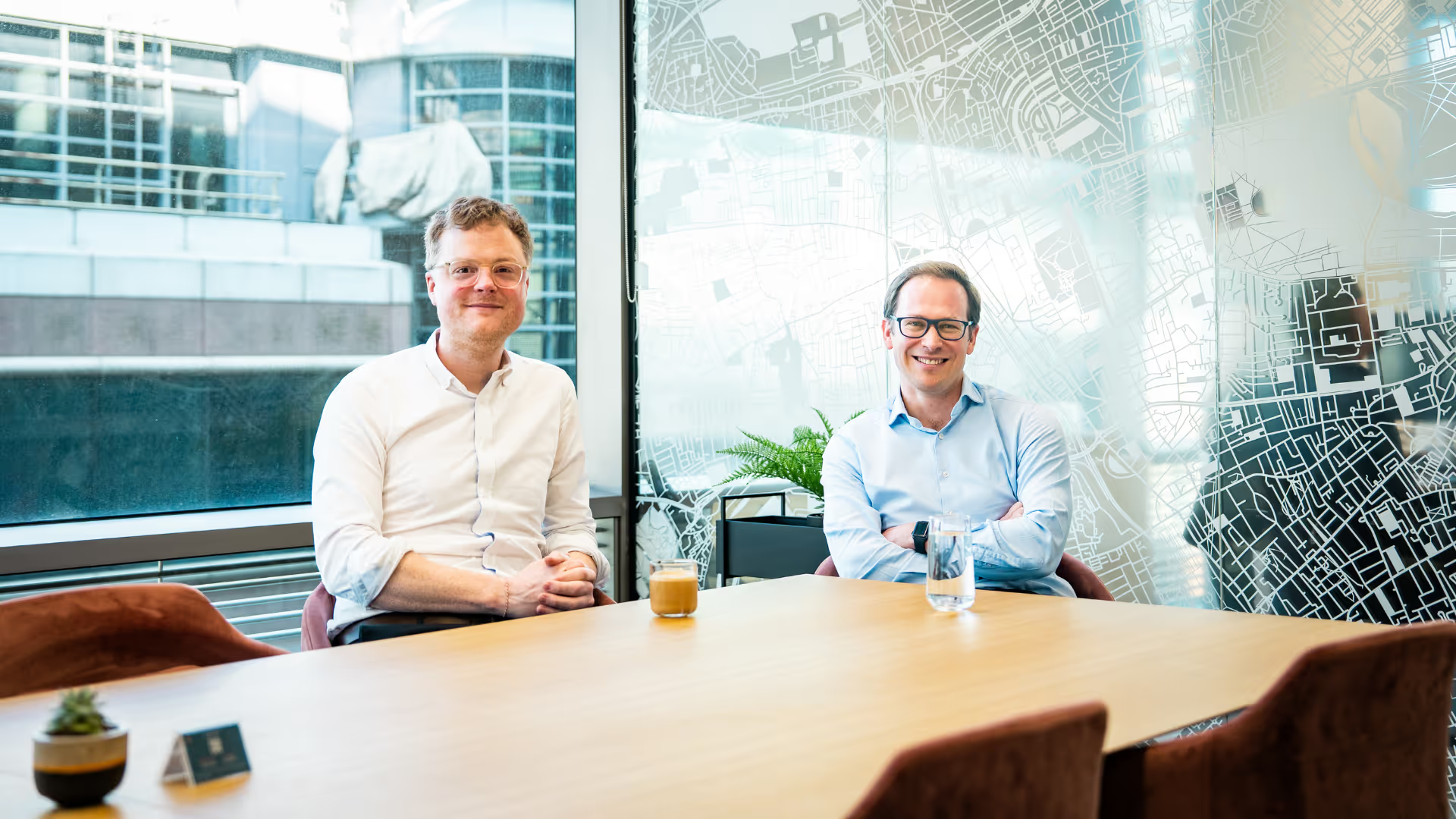
David has been central to our success as our Chief Financial Officer. Drawing on his experience at Zayo Group and RBC Capital Markets, he brings strong insight across large-scale infrastructure, investment banking and managed services. As our CFO, he’s been instrumental in shaping a commercial model that supports businesses as they grow, giving our customers the certainty and simplicity they expect.
Rhod has played a pivotal role in operations at Vorboss since 2020. He led the build of our network, now spanning over 900 km, and has raised industry standards across quality and efficiency, making sure our customers have a flawless experience. With previous roles at companies like Arup and WeWork, Rhod understands the complexity of London commercial real estate and knows exactly what it takes to deliver world-class technology in a fast-paced city.
The next chapter
Under David and Rhod’s leadership, we are doubling down on our commitment to keep things simple for our customers and remain the transparent, accountable provider ambitious businesses rely on as they grow.
“Vorboss is on path to becoming one of the UK’s leading B2B connectivity and managed service providers,”
says Adam Dunlop, Operating Partner at Octopus Capital and Chair of the Vorboss Board.
“With David and Rhod’s leadership, and the strength and commitment of the team across the business, I am genuinely excited about what lies ahead.”
Vorboss is part of the Fern Trading Group, managed and advised by Octopus Investments. This partnership, backed by £250million in funding, enabled us to build an independent, 100Gbps London fibre network and connect thousands of businesses across the capital. Having expanded our offering with a range of cybersecurity and managed technology solutions last year, we continue to do things differently by delivering everything end-to-end through our in-house teams.